Coursera (COUR)·Q4 2025 Earnings Summary
Coursera Revenue Beats by 3.5% as Udemy Merger Advances; Stock Rises After Hours
February 5, 2026 · by Fintool AI Agent
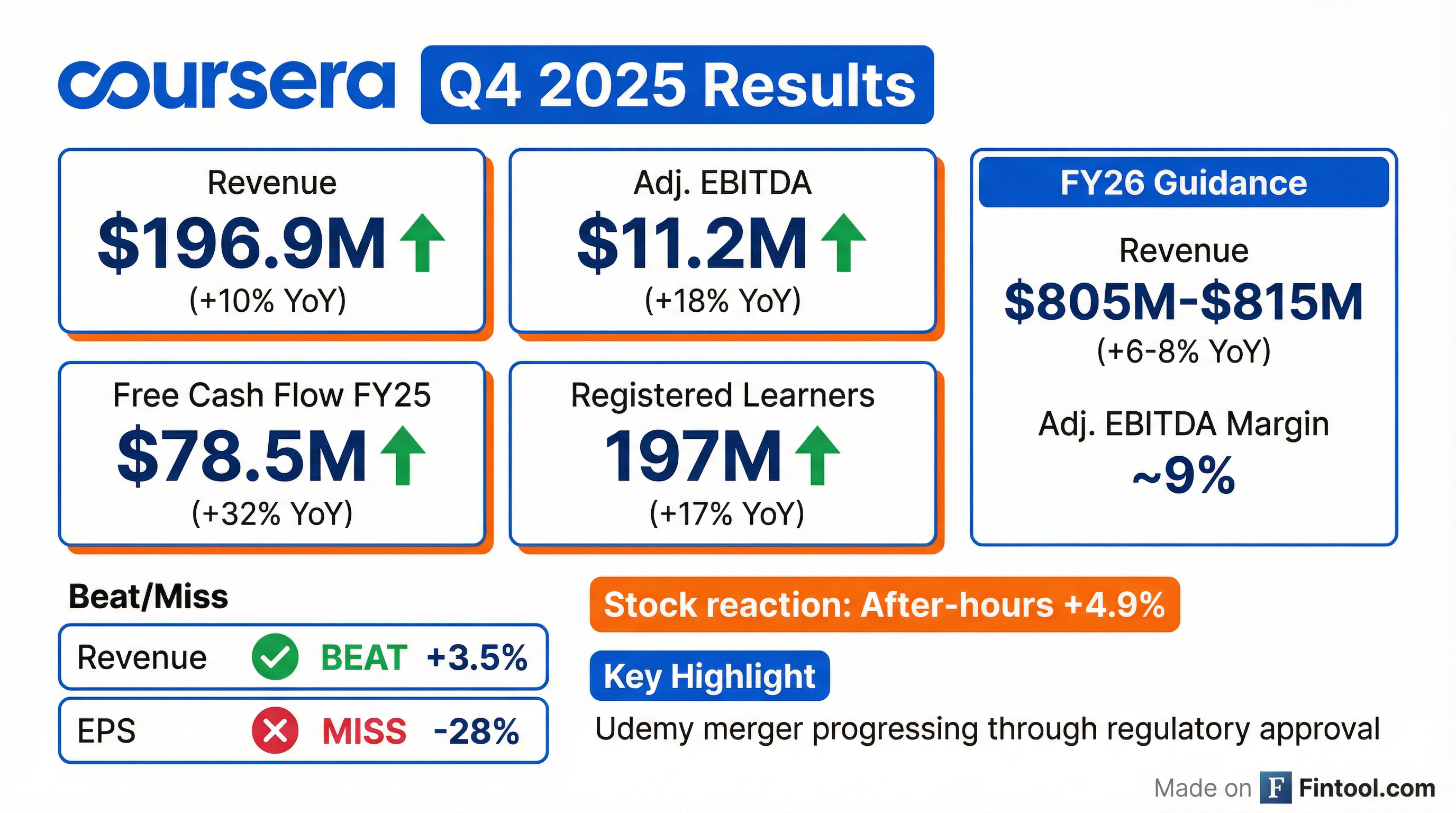
Coursera delivered Q4 2025 revenue of $196.9 million, up 10% year-over-year and beating consensus by 3.5%. The online learning platform closed out FY 2025 with $757.5 million in total revenue (+9% YoY), record free cash flow of $78.5 million (+32% YoY), and continued progress on its proposed combination with Udemy. After-hours trading saw the stock rise approximately 5% following the release.
Did Coursera Beat Earnings?
Revenue beat, EPS mixed. Coursera exceeded consensus revenue expectations while showing continued improvement in profitability metrics:
The EPS miss reflects $11.9 million in M&A-related transaction costs incurred during the quarter related to the Udemy merger. Excluding these one-time costs, underlying profitability trends remained strong.
Full-year results showed meaningful improvement:
CEO Greg Hart noted: "2025 marked the early phase of this work. As the year progressed, we began to demonstrate tangible progress reflected in our results... I'm proud of the early progress our team has made, and I'm equally clear that we must and will continue to move faster."
 Ask Fintool AI Agent
How Did the Stock React?
COUR shares closed the regular session at $5.98, down 1.5% on the day. However, after the earnings release, the stock jumped approximately 4.9% in after-hours trading to $6.27. The positive reaction suggests investors are focused on:
- Revenue beat and acceleration — Q4 revenue growth of 10% exceeded Q3's 10% growth
- Margin expansion trajectory — Adjusted EBITDA margin improved 240bps for the full year
- Strong cash generation — Record free cash flow provides financial flexibility
- Merger synergy potential — Udemy combination could accelerate growth
The stock has declined significantly from its 52-week high of $13.56, weighed down by broader ed-tech sector weakness and merger uncertainty. Current price implies a market cap of approximately $1 billion.
What Changed From Last Quarter?
Consumer segment accelerated, Enterprise held steady:
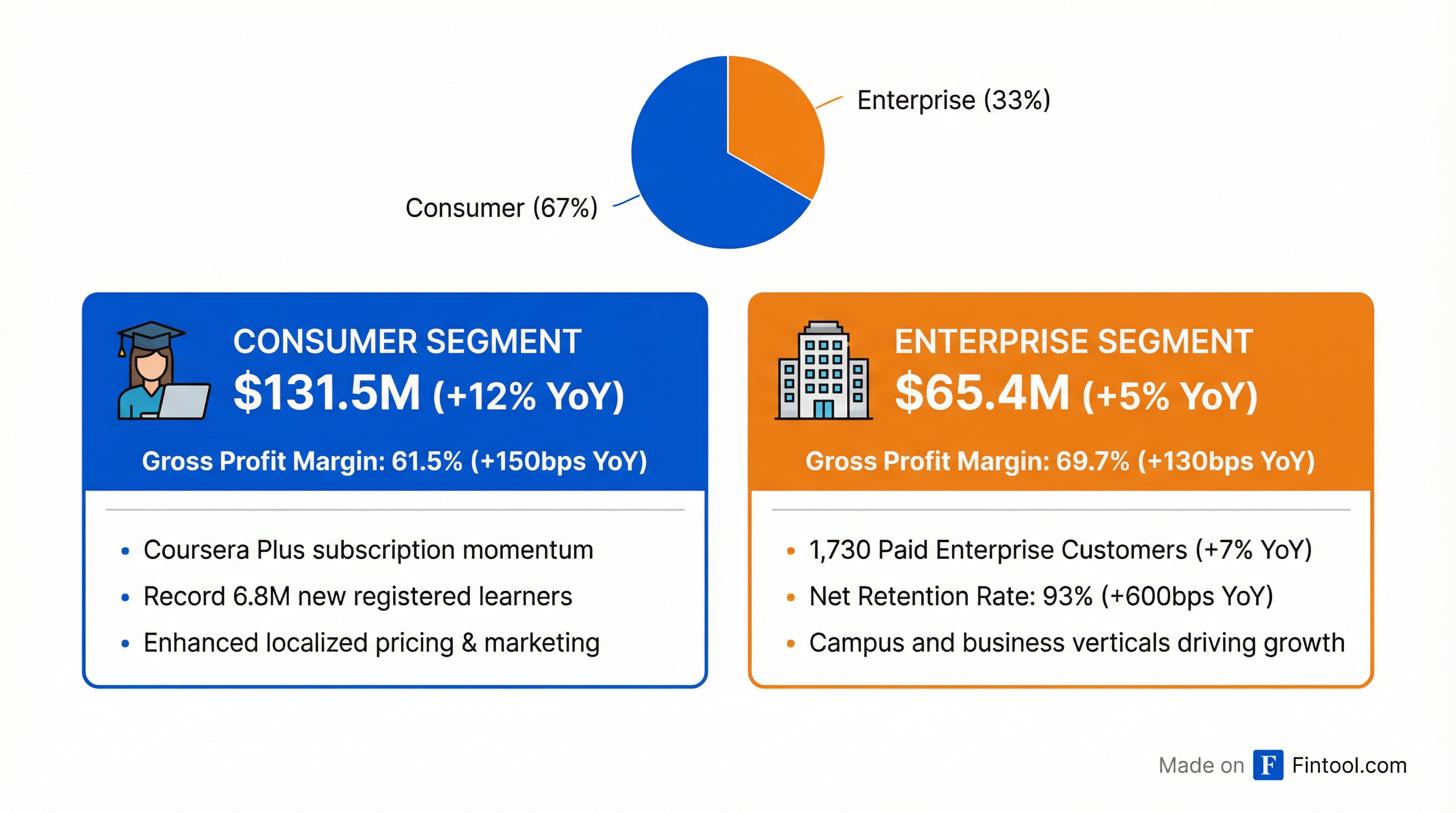
Consumer momentum building: The Consumer segment drove the quarter, powered by Coursera Plus subscription adoption, enhanced marketing capabilities, and localized pricing. The company added a record 6.8 million new registered learners in Q4 — the highest fourth-quarter additions in Coursera's history. Total registered learners reached 197 million, up 17% YoY.
Enterprise stabilizing: While Enterprise growth of 5% lagged Consumer, key metrics improved. Net Retention Rate for Paid Enterprise Customers jumped to 93%, up 600 basis points year-over-year and 400 basis points quarter-over-quarter. Paid Enterprise Customers grew 7% to 1,730.
Margin improvement driven by content mix: Both segments saw gross margin expansion as learners increasingly engaged with content produced under more favorable revenue-share arrangements. These arrangements feature lower content costs, reflecting the growing role of Coursera's technology and AI-powered authoring capabilities.
What Did Management Guide?
FY 2026 guidance reflects continued execution:
Segment-level outlook:
- Consumer: Expected to grow 10%+ YoY, with a ~100bps headwind from the degrees product category
- Enterprise: Low-single-digit growth, with no assumed material change in macro environment
Key guidance details:
- Q1 bottom-line will be lower due to seasonal investment timing and ~$14M in expected merger-related cash payments
- Consumer segment margin expansion expected in H2 2026; Enterprise margin improvement in 2027 due to multi-year contract revenue recognition dynamics
- Platform fee introduction (15% on new sales) will gradually contribute to margin improvement
- Increased R&D investment planned for 2026 — "part of that is hiring that we've already done, and part is continued investment in software tools and more engineering and product"
Ask Fintool AI AgentWhat's the Status of the Udemy Merger?
On December 17, 2025, Coursera and Udemy announced a definitive all-stock merger agreement. Key details:
- Transaction structure: All-stock combination with Coursera as the surviving entity
- Board approval: Unanimously approved by both boards of directors
- Shareholder support: Insight Venture Partners (Udemy) and New Enterprise Associates (Coursera), plus Chairman Andrew Ng, have signed support agreements
- Status: Advancing through regulatory and shareholder approval processes; timing could range from earlier than H2 2026 to later
Pro forma combination metrics:
Strategic rationale: CEO Greg Hart emphasized complementary strengths: "Udemy has 85,000+ instructors from around the world creating content in a huge range of languages... We believe that will be a fantastic addition to better serve learners around the world." Coursera is ahead on consumer product, Udemy on enterprise — the combination brings both under one platform.
Post-close plans: Management indicated plans for a "sizable share repurchase program" following transaction close. A majority of the $115M cost synergies are expected in the first year post-close, primarily through optimized go-to-market and streamlined G&A.
What Did Analysts Ask About? (Q&A Highlights)
Platform Fee Structure (Stephen Sheldon, William Blair): The 15% Platform Fee applies to new revenue from eligible content — it comes "off the top" before calculating revenue share payments to content partners. CEO Greg Hart clarified: "There's no change to consumer pricing or enterprise pricing connected with the Platform Fee." Content partners are "curious to get better visibility" into how the fee enables investment, but are pleased with recent growth momentum.
Competitive Moat & Data (Josh Baer, Morgan Stanley): Management highlighted differentiated data assets — mapping skills to courses, modules, and verified assessments. "86% of learners who come to Coursera come to grow their careers," Hart noted. "46% of learners report a salary increase since enrolling." The company recently launched verified skill paths across career groupings for enterprise partners.
LLM Traffic & AI Partnerships (Nafeesa Gupta, Bank of America): Traffic from LLMs shows "higher intent" compared to traditional search, though the ChatGPT integration remains in early stages. Management continues collaborating with OpenAI on improving the experience.
International Expansion (Matt Shea, Needham): Geo-pricing has exceeded expectations and will continue expanding in 2026. AI dubbing will expand beyond the current 1,000 courses in 5 languages. Data shows learners are "far more likely to engage in courses that are in their native language."
NRR Improvement Context (Jessica, Raymond James): CFO Mike Foley was candid: "We won't be happy with our NRR number until it's, frankly, above 100%." The Q4 uptick from 89% to 93% was driven largely by one large government expansion in Asia. A new enterprise GM hired ~4 months ago has made "significant changes" to go-to-market, with impact expected in H2 2026 or 2027.
Consumer Confidence Drivers (Jessica, Raymond James): CFO Foley highlighted "real strength and momentum in our annual subscription" and an uptick in retention in Q4 as key signals supporting 10%+ Consumer segment guidance.
Q1 Sequential Decline (Devin Au, KeyBanc): Management explained the expected Q1 deceleration is partly structural — as Coursera Plus annual subscriptions grow, revenue recognition spreads over a longer period versus à la carte course purchases. Additionally, macro uncertainty weighs on Coursera for Business outlook.
Key Platform and Product Updates
AI-powered innovation accelerating:
- Coursera Coach: AI tutor now integrated into 98% of courses, available in 26 languages
- AI dubbing: Available for 1,000+ courses in 5 languages, expanding content accessibility
- Course Builder: AI-powered authoring tool enabling custom course creation at scale
- Verified Skills Paths: Role-specific learning pathways with verified assessments launched in September, now rolling out broadly
- Enterprise Admin Home redesign: Pilot showed improved admin-led engagement; broader rollout began in January
2026 Product Priorities (per management):
- Verified skill pathways expansion
- MCP-based discovery capabilities for learning in the flow of work
- Deeper integrations with HR/LMS platforms and AI collaboration tools
Content ecosystem expansion:
- Catalog expanded 45%+ YoY — fastest pace in 5 years
- 13,500+ courses from 375+ university and industry partners
- GenAI courses seeing 15 enrollments per minute, up from 8 in 2024
- New partnership with Anthropic for hands-on Claude training
- Cleveland Clinic joined in January with AI courses for clinical settings and medical imaging
- New AI courses announced for nursing, healthcare, business, legal, and communications roles from Vanderbilt, CU Boulder, and Macquarie University
Balance Sheet and Cash Position
Coursera ended 2025 with a fortress balance sheet:
The $792.6 million cash position and zero debt provide significant flexibility for the Udemy integration, continued platform investment, and post-merger capital returns.
What Should Investors Watch?
Near-term catalysts:
- Udemy merger regulatory approvals and shareholder votes (H1 2026)
- Q1 2026 results showing Consumer segment trajectory
- Platform fee impact on gross margins starting Q2
Key risks:
- Merger integration execution and timeline uncertainty
- Enterprise spending sensitivity to macro conditions
- Competitive pressure from free/low-cost learning alternatives
- AI disruption to traditional course content value proposition
Management credibility: Coursera exceeded its initial 2025 guidance targets meaningfully — revenue guidance was raised from 4% to 9% growth during the year, and Adjusted EBITDA margin targets were raised twice (from 7.0% to 8.0% to 8.4% delivered).
Ask Fintool AI AgentCoursera reports Q1 2026 earnings in May 2026.
Related: COUR Company Profile | Q4 2025 Earnings Call Transcript | Q3 2025 Earnings